
Looking Back on April: Storytelling, Systems, and Riding the Wave
by Ashley Graham-Wilcox
Could Easter really have been only a month ago? April felt like six different seasons packed into 30 days.
My family squeezed in a spring break trip to Lake Tahoe where my very brave 40-something husband tried snowboarding for the first time with our son. We virtually queued for Olympics tickets (you’ll recall I’m a devotee) and are the proud holders of once-in-a-lifetime women's soccer final tickets and sure-this-will-be-fun archery ones for the local games coming to an arena near us for #LA28. Long before any hometown Olympic glory, I somehow found myself at two away baseball games this month — both with shockingly popular + painful giveaways.
One church client is navigating a rector transition. Another is managing overlapping fundraisers. A third is preparing for its first-ever clergy sabbatical. And, somehow, summer is already knocking at the door, and, in a plot twist no parent can ever fully prepare for, my sixth grader — who spent months confidently declaring he had to attend the neighborhood junior high — abruptly changed his mind because... adolescence. Why not. So, paperwork.
I had the privilege this month of attending two back-to-back conferences, Episcopal Communicators (#EpisComms) in San Diego and our own Caffeinated Church Conference in Atlanta — which resulted in this introvert fully collapsing into herself for several days afterward. But as always, conferences — and long drives and airport rides home — tend to clarify things.
So, here’s some breaking new(s) learnings from April:
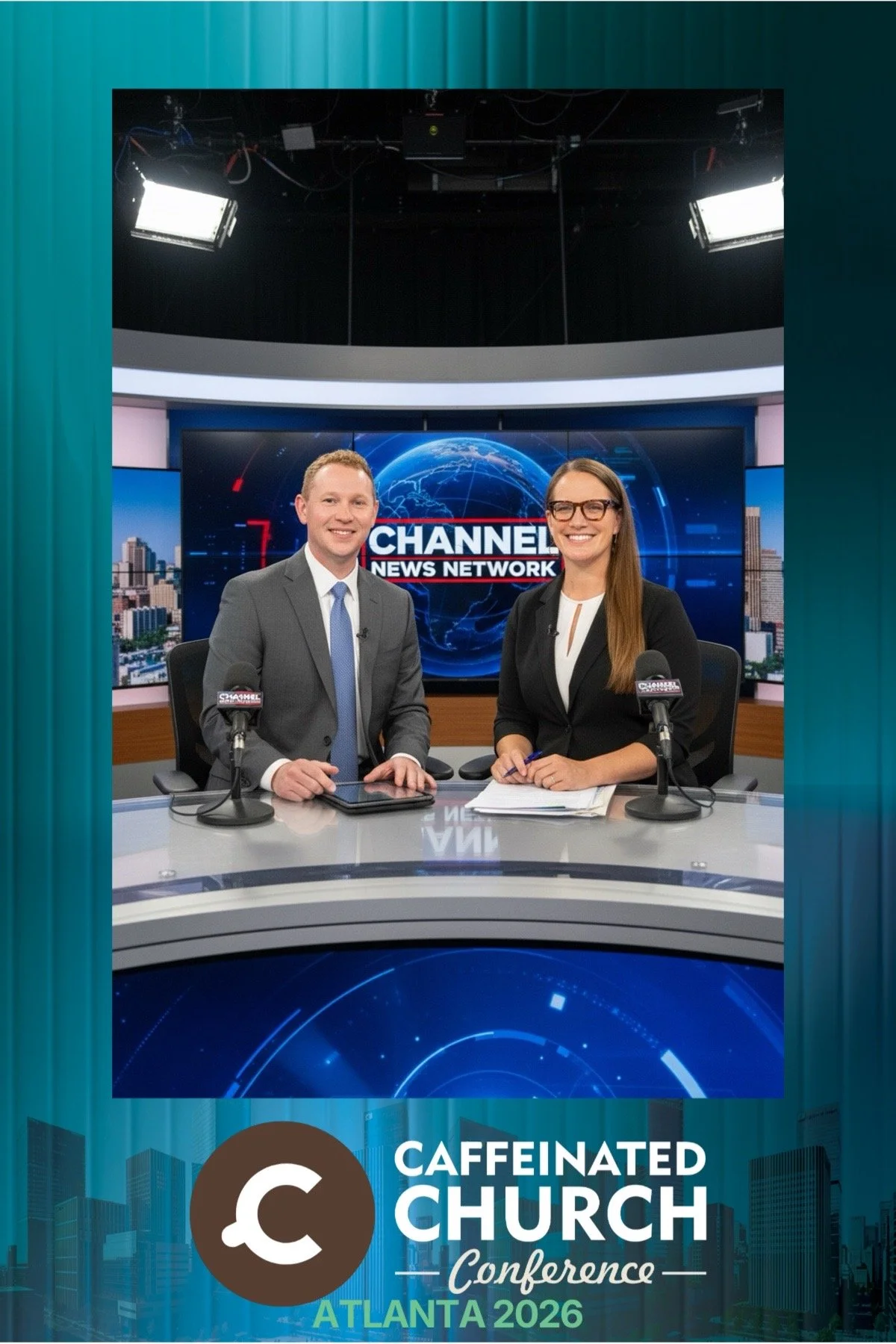
Can’t go wrong with a photo booth
It’s all about people
This feels obvious, but it’s worth repeating because ministry work can quickly become dominated by logistics: Registration links. Graphics requests. Last-minute bulletins. Budget questions. Website edits. “Can you send one quick email?” And yet the most meaningful part of this month was conversation.
The people I met.
The ideas shared over coffee.
The “we’re dealing with that, too” moments.
The unexpected or long over-due collaborations that are now taking shape.
Professional community matters, especially in church work, where many of us are carrying highly visible responsibilities with very little institutional support. Find your people. Keep them close. Be one of those people for someone else. That’s why spaces like Caffeinated Church and Episcopal Communicators exist in the first place.
We need more storytelling. Far fewer announcements.
This month reinforced something I know intellectually (and even co-wrote a grant alllll about) but still have to fight for in practice: When timelines get tight and inboxes get loud, communications can quickly become reactive. You stop telling stories and start posting announcements. You become an internal task rabbit for everyone else’s urgency, and before long, the website reads like a bulletin board and your Instagram is a list of reminders. Stories are what help people understand why your community matters. Stories help people see themselves in your mission. Stories can be the difference between someone scrolling past and someone leaning in.
At the Caffeinated Church Conference, nowhere was this clearer than listening to Flamy Grant at the Margaret Mitchell House. People remember honesty. They remember specificity. They remember stories that make them feel something. So, I say this to you, and I say it to me: Stay the storytelling course.
Use the good photos
“No one cares about that guy in that photo.” This is what Emily from Evoke Marketing told me this month, and I may carry it with me for the rest of my communications career. I was telling her about a church website redesign where I had carefully selected strong, authentic photos that actually reflected community life — only to be asked to remove nearly all of them.
“That family moved.”
“That person left in a huff a few years ago.”
“That person doesn’t speak to that person anymore.”
Now, mind you, all of these photos were still sitting on their shared photo server, and no one had mentioned any of this when they hired me to redesign their website.
Do we need to be thoughtful about photo permissions, youth restrictions, and copyright? Absolutely. Could there occasionally be someone who wonders why they’re featured on a church website they no longer attend? Sure. But honestly? Mostly nobody cares.
Your visitors are not conducting a forensic investigation into your congregation’s interpersonal history. They’re trying to figure out whether your community feels warm, alive, and worth visiting.
Use the good photos.
Sunshine helps
Mid-morning rooftop breaks in San Diego and a perfect weather week in Atlanta reminded me how much clearer everything feels when you step outside.
Take your lunch break.
Walk around the block.
Touch grass.
Sit in sunlight.
Your best idea may not happen at your desk.
Build systems before you need them
I continue to be fascinated by one question: How are people actually getting their work done?
Not theoretically. Practically.
What templates are they using? What workflows actually work in the church week and year? What approval processes have they created? What recurring tasks have they documented?
And how can I (respectfully) steal all of them?
So many church teams are running on institutional memory and heroic effort. That works — until someone goes on sabbatical. Or resigns. Or burns out. Or wins the lottery and disappears forever. (I wish this for all of you.)
Build the system now. Future-you (us) will be grateful.
Ride the wave
In one workshop I led this month, we talked about how teams and organizations move in cycles. Because I’m a camp counselor at heart and will never shake it, I framed it as the Ormings — Forming, Storming, Norming, and Performing — the quintessential stages of group development. Call them what you want: Not every week will feel efficient. Not every season will feel clear. Not every initiative will move in a straight line. Ride the wave.
☕Final thought
The best communicators I know are learning how to build strong systems while staying flexible enough for real life. They tell meaningful stories while managing deeply unglamorous spreadsheets. They create welcoming experiences while quietly solving logistical problems no one else sees. And often, the most meaningful work happens in what can feel like very small moments:
A thoughtful photo choice.
A better workflow.
A story well told.
A conversation over coffee.
A breath of fresh air between meetings.
So:
Join professional communities.
Learn from people outside your bubble.
Borrow good systems.
Tell better stories.
Go outside when possible.
And when things feel chaotic?
Ride the wave.
